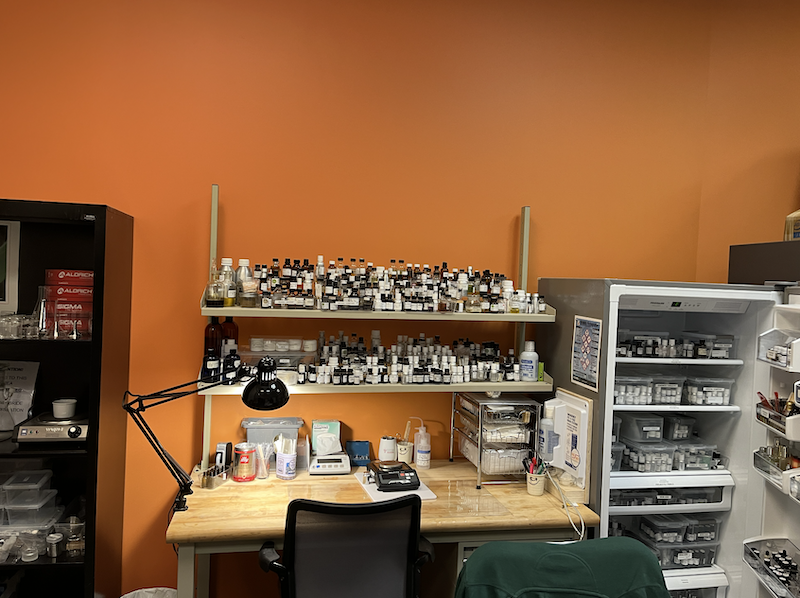
Lab workbench, glassware cabinet, and materials fridge.
The research-informed design and infrastructure of The Aroma Inquiry Lab reflect insights developed from my site-specific doctoral field work research on aroma-focused learning ateliers and scent-themed features in the built and natural environments, such as the UNESCO Heritage site of Grasse, France [as described in my dissertation] and other scent-rich learning environments I have visited and practised in elsewhere in North America. The lab functions to create a space dedicated to the missing modality of aroma within the Responsive Ecologies lab’s larger emphasis on tangible, embodied, sensory, and environmentally ‘responsive’ approaches to teaching, learning, research, and research prototype fabrication.
A materials-centred focus

Raw materials used to teach the public about scent in Grasse, France, include two giant pieces of vetiver, passed around to visitors during tours.
The intentional choice of the word aroma, rather than smell, is intended to distinguish the material basis of the space as opposed to labs focused on the functional dimensions of olfaction. The word ‘aroma’ once referred not only to the scent of aromatic raw materials but also their source (i.e., spices, etc). Whereas my use of the term ‘inquiry’ reflects the lab’s pedagogical orientation to inquiry-based learning, which is the kind of learning that is circulated in informal learning environments such as communities of practice rather than the formal institutional locations such as classrooms, lecture theatres, or discipline-specific labs.
The naming of the Aroma Inquiry Lab is thus an explicit statement of purpose as an extra-disciplinary environment for (internal) research and knowledge mobilization projects across varied academic and cultural contexts. The lab also functions in support of undergraduate and graduate class visits and tours that provide hands on opportunities to understand the tangible affordances of aromatic materials, objects, and environments as modal resources for learning, communicating, and knowledge dissemination from a variety of perspectives.
Infrastructure

Full body safety wash station.
While the aroma lab is not designed for manufacturing, it features a research-informed and purpose-built infrastructure, which includes the types of features and affordances required for safe practices with chemical mixtures (FYI, essential oils are just that – chemical mixtures). This includes a full-body safety wash station, several mobile eye wash stations, targeted ventilation, flammable materials safes, downdraft tables, locking cabinets and drawers, a dedicated dishwasher (used only with aroma materials), a dedicated refrigerator with a locking system (used only for aroma materials), and WHMIS labelling for materials.
While my role as operator of the aroma lab’s infrastructure is not my full-time occupation, my labour maintaining the lab is supported indirectly through the in-kind support for my research activities and collaborations on knowledge mobilization projects with internal and external researchers, industry partners, cultural practitioners, and public institutions in Canada and internationally. While the majority of material resources in the lab consist of my own resources and archival materials, I also manage small collections of materials that are provided by collaborating researchers and knowledge mobilization partners for the creation of specialized workshops, learning and training standards, scent-themed research prototypes, and cultural heritage mediation.